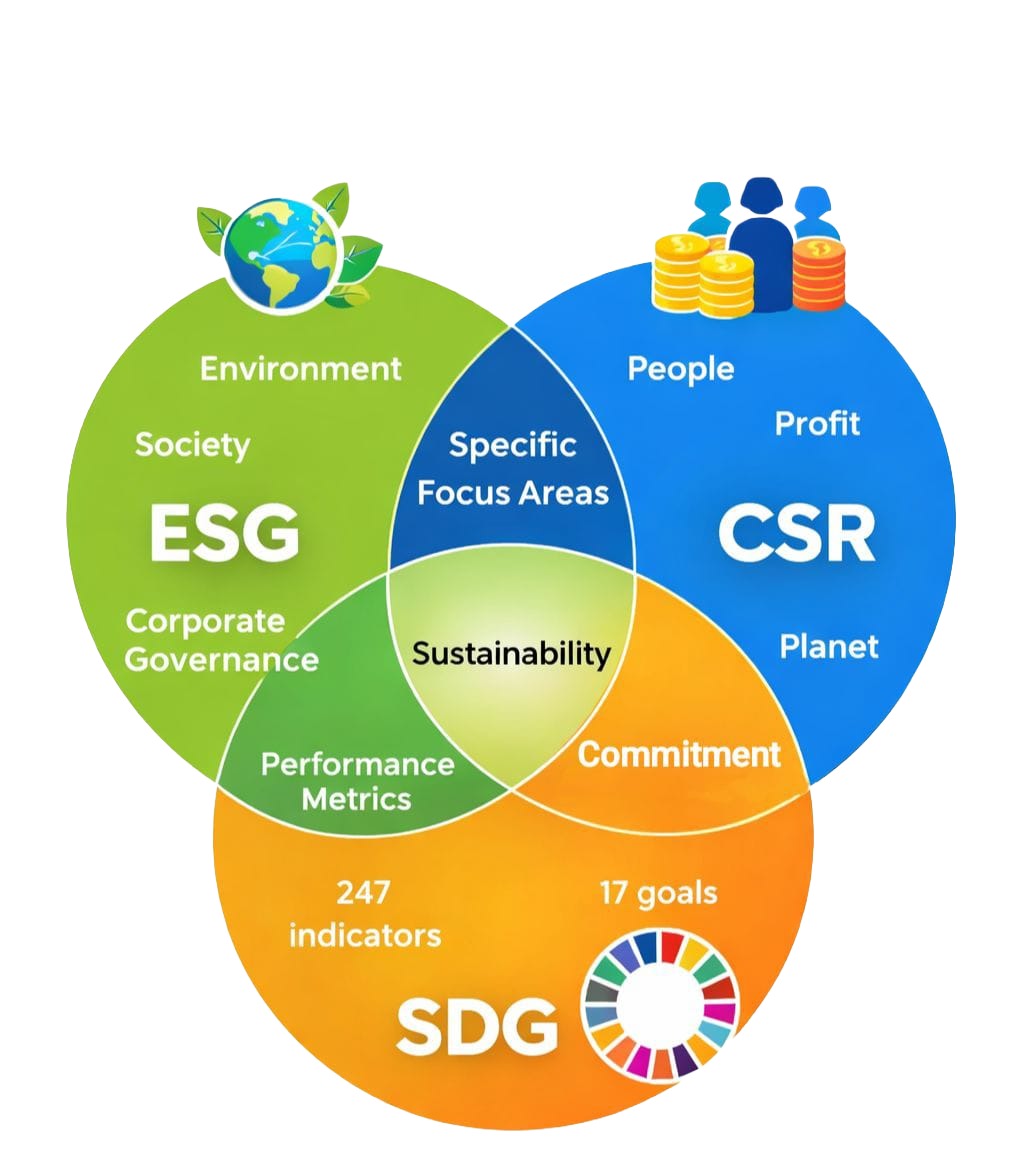
Every year, companies publish glossy sustainability reports, governments launch ambitious development plans, and corporate leaders speak passionately about Environmental, Social and Governance (ESG), Corporate Social Responsibility (CSR), and the Sustainable Development Goals (SDGs). These terms have become part of everyday business language. Yet for many people, they remain little more than fashionable acronyms.
The average citizen is less interested in corporate jargon than in practical outcomes. People want clean air and water, decent jobs, quality healthcare, reliable infrastructure, ethical leadership, and thriving communities. They want businesses that pay fair wages, protect the environment, respect human rights, and contribute meaningfully to national development. In essence, they want responsible institutions that improve lives rather than merely improve public relations.
That is why it is important to distinguish between ESG, CSR and the SDGs—and to understand what each should mean for the public.
Corporate Social Responsibility has traditionally been the visible face of corporate goodwill. Companies build schools, donate medical equipment, support educational scholarships, sponsor community projects, and respond to humanitarian emergencies. These contributions remain valuable and deserve recognition. However, CSR should never become a substitute for responsible business practices. A company cannot pollute rivers throughout the year and expect a single tree-planting exercise or charitable donation to erase its environmental footprint.
This is where ESG becomes critically important. Unlike CSR, ESG examines how an organisation actually conducts its business. It evaluates environmental stewardship, employee welfare, workplace safety, diversity and inclusion, ethical governance, transparency, accountability, and anti-corruption practices. Investors increasingly rely on ESG indicators because they recognise that organisations built on integrity and sustainability are more resilient over the long term.
The Sustainable Development Goals occupy a different but equally important space. Adopted by the United Nations in 2015, the 17 SDGs provide a global roadmap for ending poverty, improving education and healthcare, promoting decent work, achieving gender equality, protecting the environment, and fostering inclusive economic growth. Governments, businesses, civil society organisations, and citizens all have roles to play in achieving these shared objectives.
Together, CSR, ESG and the SDGs should reinforce one another. CSR reflects an organisation’s commitment to society. ESG measures whether its operations are responsible and sustainable. The SDGs define the broader destination that nations and institutions should strive to reach.
Unfortunately, the gap between commitment and implementation remains a significant challenge.
Many organisations have become adept at communicating sustainability while making only incremental changes to their operations. Sustainability reports often highlight successes but minimise shortcomings. Marketing campaigns showcase environmental responsibility while communities continue to experience pollution, poor labour conditions, or inadequate stakeholder engagement. This phenomenon—commonly described as greenwashing—undermines public confidence and weakens genuine sustainability efforts.
The public should not be satisfied with attractive reports or impressive slogans. Citizens have every right to ask difficult questions. Is the company reducing its emissions? Are employees receiving fair treatment? Are host communities benefiting from business activities? Are environmental standards being respected? Is corporate leadership transparent and accountable? Are sustainability claims independently verified?
These questions are not expressions of cynicism; they are essential elements of responsible citizenship.
Businesses, for their part, must recognise that public trust is earned through measurable action rather than polished communication. Sustainability commitments should be accompanied by clear targets, transparent reporting, independent verification, and regular progress updates. Successes should be celebrated, but challenges should also be acknowledged honestly. Transparency builds credibility far more effectively than perfection.
Governments equally have an indispensable role. Effective environmental regulation, robust labour protections, strong anti-corruption institutions, and transparent governance provide the foundation upon which responsible business can flourish. Public policy should reward organisations that operate responsibly while holding accountable those whose actions harm people or the environment.
The media and civil society also have a responsibility to scrutinise sustainability claims with the same rigour applied to financial performance. Public discourse should move beyond corporate branding to measurable social impact. Journalism, research institutions, and community organisations can help ensure that ESG and CSR remain instruments of accountability rather than exercises in reputation management.
Ordinary citizens should not underestimate their own influence. Consumers can support responsible businesses through informed purchasing decisions. Employees can advocate for ethical workplace practices. Investors can prioritise companies that demonstrate sound governance and sustainability. Communities can demand consultation and transparency. Voters can support policies that promote sustainable development and institutional accountability.
Ultimately, ESG, CSR and the SDGs should not exist merely to satisfy investors, regulators, or international reporting frameworks. Their true purpose is to improve people’s lives. They should produce cleaner environments, stronger institutions, safer workplaces, better schools, accessible healthcare, inclusive economic opportunities, and communities that can thrive for generations.
The public deserves more than promises. It deserves measurable progress, honest leadership, and institutions that understand that sustainability is not a public relations strategy but a public responsibility. Until ESG, CSR and the SDGs consistently deliver tangible improvements in people’s daily lives, citizens should continue to ask questions, demand transparency, and expect better.
That expectation is not unreasonable. It is precisely what responsible governance and responsible business should deliver.